


London enters my research through painting. I am interested in approaching a context shaped by a particular tradition of figurative painting — one in which the body, intimacy, autobiography and psychological presence have been persistently negotiated. Artists such as Francis Bacon, Lucian Freud, David Hockney, Tracey Emin, Chantal Joffe, Cecily Brown, Celia Paul, Celia Hempton and Somaya Critchlow, alongside key references in my practice such as Paula Rego, Marlene Dumas and Joan Semmel, form a constellation through which I approach this context, offering distinct ways of thinking about what it means to make an image from proximity.
My work begins with intimacy: photographs, bodies I have known, domestic spaces, objects left behind, fragments of encounters. Through painting, drawing and printmaking, I return obsessively to these images, asking what happens when desire becomes a way of looking — particularly when a woman occupies the position of the desiring subject and turns her gaze towards male bodies.
Coming to London is therefore less an arrival at a new subject than a displacement of an existing practice. That displacement also involves the place from which I arrive. As an artist from Ceará, I am interested in what happens when a practice formed there circulates beyond the narratives through which art from northeastern Brazil is often framed, and enters other histories and contexts on its own terms. I want to place my work in conversation with a different pictorial genealogy and, at the same time, allow the city to interfere with it: its distances and proximities, its images, its rhythms, its ways of seeing and being seen.
I arrive carrying images with me.
I am interested in what happens to them
when the place from which I look changes.

In September 2026, Alice Dote will become the inaugural artist-in-residence of CONSTELAR, a London-based research initiative founded by British curator and gallerist Florence Woodfield Morais. Dedicated to creating new constellations of exchange between Ceará and the United Kingdom, the programme supports research and development for artists based in the northeastern Brazilian state, bringing their practices into dialogue with artists, curators, institutions and other cultural practitioners in the UK.
CONSTELAR begins from the recognition of Ceará as a region with a vital contemporary art scene whose histories and current production remain significantly under-researched and underrepresented, both within Brazil and internationally. Rather than treating this distance from established art centres as something to be overcome, the programme seeks to create sustained exchanges through which different artistic contexts, histories and forms of knowledge can encounter one another.

Invited by Woodfield Morais to inaugurate the programme, Dote will undertake a month-long, individually structured residency combining studio practice, research and critical exchange. Based in a 24-hour studio in Hackney Wick, she will work in dialogue with Woodfield Morais and invited artists and professionals, alongside studio and gallery visits, reading groups and encounters developed in response to her research.
During the residency, Dote will further develop the research that informed her recent solo exhibition o nome disso não é fome [the name for this is not hunger], investigating the sexual politics of looking through painting. The project approaches intimacy as a method and painting as an erotic procedure: one capable not only of representing desire, but of producing it. In London, these questions will extend into an investigation of images of masculinity and of what happens when an intimate, autobiographical practice is displaced into another cultural and pictorial context.
The residency will culminate in the presentation of work developed in London through an exhibition and open studio, as well as Dote’s participation in Paraíso, the UK’s first art fair dedicated to Latin American art. Together, these moments will bring the research developed in the studio into public circulation, creating new encounters between Dote’s practice and London’s artistic community.

RESEARCH IN LONDON
What does desire do to looking?
My research in London begins with intimacy — not as a subject, but as a method of approaching images. I am interested in what desire does to looking, and in what painting can do with the images produced within intimate relationships: photographs, fragments of bodies, gestures, objects, screens and traces of encounters.
Rather than arriving with a project to be completed, I bring a set of questions that will be tested through painting, drawing, writing and the experience of displacement itself.
01. INTIMACY AS METHOD
What changes when intimacy becomes a way of making images?

My work begins close to the body: with photographs taken within relationships, domestic spaces, gestures, objects and images that were never originally intended to become public. I am interested in intimacy not simply as something represented, but as a condition of looking — a distance from which images are produced, withheld, repeated and transformed.
02. EROTICISM AS PROCEDURE

I understand eroticism as a procedure that operates through distance, proximity, withholding and excess. Painting is also a body-to-body encounter: I move towards and away from it, touch its surface, cover and uncover it, repeat gestures, look again. Desire enters not only through what is depicted, but through this physical negotiation between my body and the body of the painting.
What happens when painting becomes a body-to-body encounter?

03. IMAGES OF MASCULINITY
What happens when a woman sustains a desiring gaze upon the male body?
Many of the men who appear in my paintings are photographed within intimate relationships, often in moments in which the body is neither performing strength nor offering itself as spectacle. I am interested in images of masculinity marked by rest, exposure, softness and vulnerability — and in the instability produced when the male body becomes the object of a desiring female gaze without simply reversing the violence historically embedded in looking.


04. IMAGE, WORD, SURFACE
Photography is embedded in my painting practice. Many works begin with images made on a phone and retain the 16:9 proportions of the digital screen as they become paintings. The same photographs may return through drawing, printmaking and painting, as if no single material form could exhaust them. Writing belongs to this same movement: words, notes and titles do not explain the images, but approach them from another distance, sometimes revealing what the image withholds and sometimes making it more unstable. In London, I want to investigate this circulation more deliberately — photograph, screen, drawing, painting, print, word, repetition — and the different kinds of distance each form creates.
What does repetition do to an image as it moves between surfaces?


What happens to an image when the place from which I look changes?


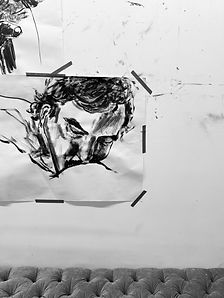


BODY-TO-BODY WITH LONDON
During the residency, this space will gather fragments produced through my encounter with London — drawings, paintings, photographs, words, notes and images in progress. Not a record of the city, but an attempt to understand what happens when a practice built through intimacy encounters another place body to body.
I don't know yet what London will ask me to look at.

WORDS
Selected texts
"Her paintings hold that contradiction with unusual tenderness and tension. They bring the viewer close, then make closeness ethically difficult, turning the act of seeing into an encounter with desire, vulnerability, and the limits of what another person's image can disclose."
"In my work, desire doesn't simply choose an object: it attaches itself to gestures, objects, leftovers, fabrics, meals, conversations, traces of encounters. When men appear in these works, for example, they become part of a visual economy that has already been transformed by desire. So, rather than “represent” desire, I'm interested in how painting can eroticize everyday life, and even create an atmosphere, a posture, a way of seeing things, before it identifies an object. In that sense, intimacy becomes a method. It is through lived intimacy that these images emerge, and it is through painting that they continue unfolding."
Read more: What I painted when I gave up painting
(Paula Plee, book "Alice Dote", Barléu Editora, 2026)
"Between gestures, traces, everyday objects, fragments of bodies, and words addressed to another, the artist insists on proximity as a way of relating to the world. Painting, drawing, observing, and allowing oneself to be affected become means of remaining both satiated and alive."
IN CIRCULATION
The residency as it enters public conversation — press, interviews, publications and other forms of circulation.

OXIGÊNIO REVISTA — SEPTEMBER 2026
CONSTELAR: um novo mapa para a arte brasileira
Feature by Maria Hermínia Donato on CONSTELAR, with an interview with Florence Woodfield Morais.

SEE THE WORK IN LONDON
Upcoming


